
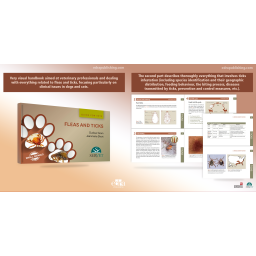
Very visual handbook aimed at veterinary professionals and dealing with everything related to fleas and ticks, focusing particularly on clinical issues in dogs and cats. The first part is entirely dedicated to fleas (including their identification, life cycle, clinical signs derived from flea infestation, flea allergy dermatitis (FAD), and prevention and control measures, among others). The second part describes thoroughly everything that involves ticks infestation (including species identification and their geographic distribution, feeding behaviour, the biting process, diseases transmitted by ticks, prevention and control measures, etc.).
Very visual handbook aimed at veterinary professionals and dealing with everything related to fleas and ticks, focusing particularly on clinical issues in dogs and cats. The first part is entirely dedicated to fleas (including their identification, life cycle, clinical signs derived from flea infestation, flea allergy dermatitis (FAD), and prevention and control measures, among others). The second part describes thoroughly everything that involves ticks infestation (including species identification and their geographic distribution, feeding behaviour, the biting process, diseases transmitted by ticks, prevention and control measures, etc.).
Authors:
Dunbar Gram, DVM, DACVD, MRCVS
Dr. Gram is Service Chief and Clinical Associate Professor of Dermatology at the University of Florida, College of Veterinary Medicine. He received his undergraduate degree from Wesleyan University in Connecticut and his Doctor of Veterinary Medicine with high honors from Auburn University. He completed an internship at the University of Illinois and a residency in dermatology at North Carolina State University. He has taught dermatology at The University of Edinburgh, The University of Prince Edward Island and North Carolina State University.
Jeanmarie Short, LVT, DVM
Jeanmarie Short was a licensed veterinary technician before graduating from the Virginia-Maryland Regional College of Veterinary Medicine. She completed a one year rotating internship in emergency and internal medicine. After three years in general small animal practice, she completed a residency in dermatology at Animal Allergy and Dermatology in Virginia Beach, VA. Her interests are in endocrine and allergic diseases.
Table of Contents:
1. FLEAS
Introduction
General flea anatomy
Flea life cycle
On-host component of life cycle
Environmental component of the life cycle
Control measures
Prioritizing aspects of flea control products/programs
Determining the goals of a flea control program
Pathology associated with fleas
Anemia
Tapeworms
Pruritus
Dermatitis
Potential flea-transmitted diseases
References
2. TICKS
Introduction
General tick anatomy
Hard ticks
Tick feeding
Tick life cycle
Hard tick life cycle
Species identification
Rhipicephalus spp.
Dermacentor spp.
Ixodes spp.
Haemaphysalis longicornis
Otobius megnini
Tick removal
Prevention
References
Data sheet
Specific References
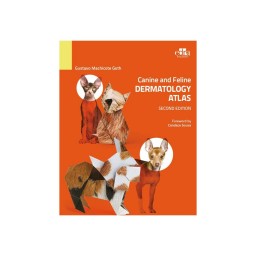
This book presents dermatological diseases categorized according to their aetiologies, using an extensive collection of pictures of the most common dermal pathologies in dogs and cats.
A practical guide detailing surgical treatments for common injuries and diseases in cats and dogs. It covers arthrology, techniques, and procedures with detailed illustrations and videos for enhanced comprehension.
For the beginning veterinary practitioner who wants to delve deeper into trauma and orthopaedic surgery and the veterinary surgeon who is well versed in this field.
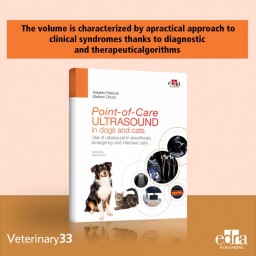
For the first time, also in veterinary medicine, a text that applies the Point-of-Care ultrasound approach (PoCUS) and which uses the understanding of the ultrasound sign within a dynamic context, that of the most common clinical syndromes in emergency and intensive care, is available.
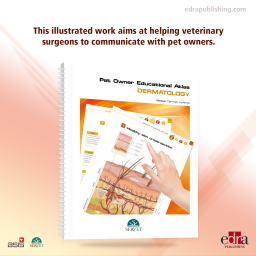
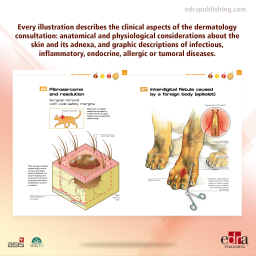
This illustrated work aims at helping veterinary surgeons to communicate with pet owners. After the previous volume about surgery, this atlas dedicated to dermatology helps the vet to explain the physiological and pathological characteristics of skin as well as the characteristics of diagnostic tests, treatments and surgical techniques. Every illustration describes the clinical aspects of the dermatology consultation: anatomical and physiological considerations about the skin and its adnexa, and graphic descriptions of infectious, inflammatory, endocrine, allergic or tumoral diseases. The clarity and accuracy of the illustrations turn this atlas into another useful clinical tool.
In the fascinating world of endocrinology, scientific knowledge and technology have advanced greatly in recent years. Alongside, the ability to diagnose, treat, and manage various endocrine disorders has progressed too. The goal of this textbook is to provide an up-to-date, comprehensive, yet accessible resource for understanding and managing endocrine disorders in dogs.
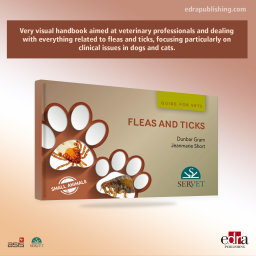
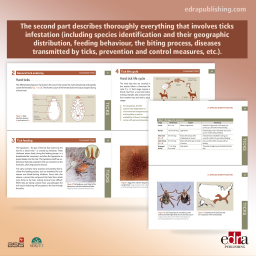
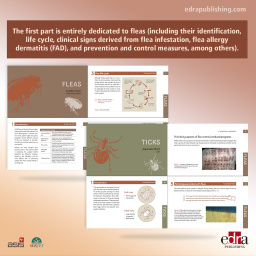
Very visual handbook aimed at veterinary professionals and dealing with everything related to fleas and ticks, focusing particularly on clinical issues in dogs and cats. The first part is entirely dedicated to fleas (including their identification, life cycle, clinical signs derived from flea infestation, flea allergy dermatitis (FAD), and prevention and control measures, among others). The second part describes thoroughly everything that involves ticks infestation (including species identification and their geographic distribution, feeding behaviour, the biting process, diseases transmitted by ticks, prevention and control measures, etc.).