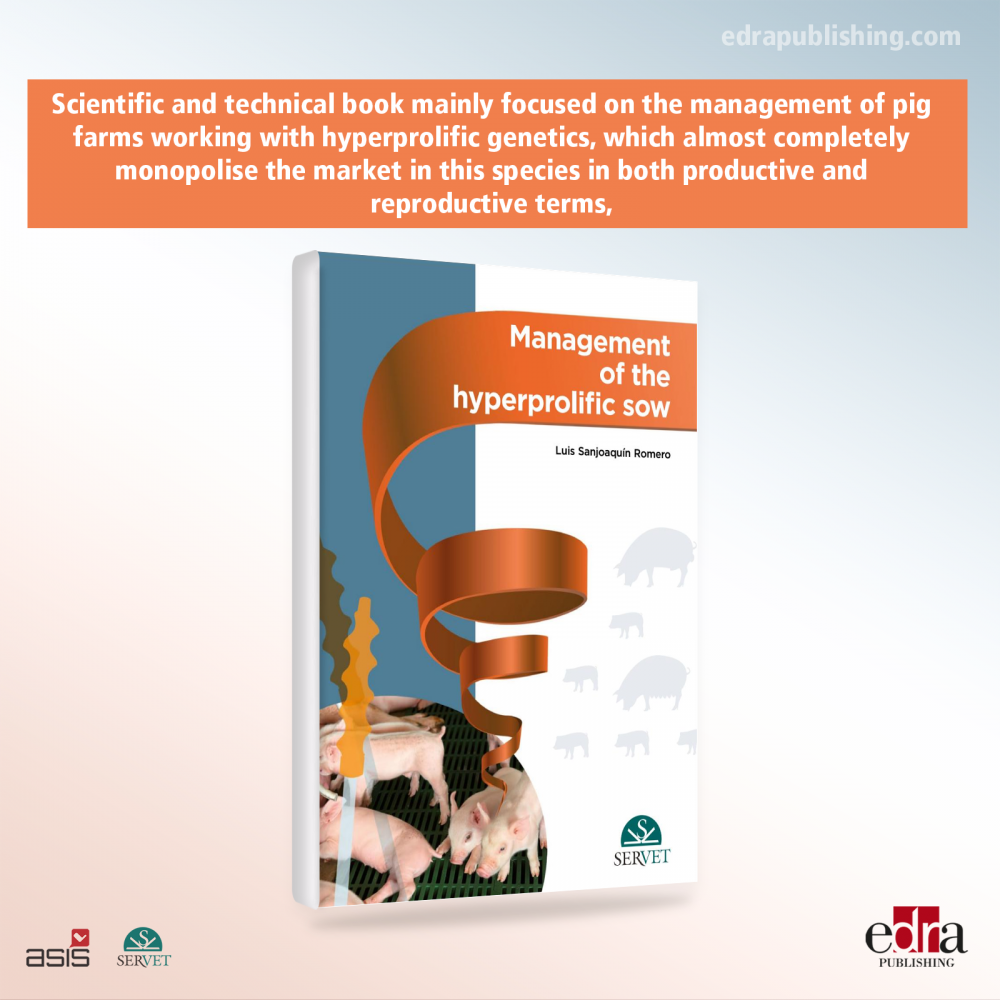

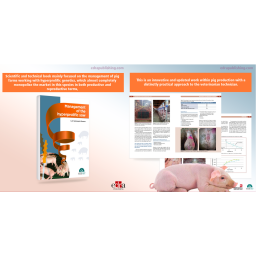
Technical work mainly focused on the management of pig farms working with hyperprolific genetics, which almost completely monopolize the market in this species in both productive and reproductive terms. The author, a renowned experienced specialist in swine genetics, provides key information to facilitate the management of these lines by veterinary professionals.
Technical work mainly focused on the management of pig farms working with hyperprolific genetics, which almost completely monopolize the market in this species in both productive and reproductive terms. The author, a renowned experienced specialist in swine genetics, provides key information to facilitate the management of these lines by veterinary professionals.
Author:
LUIS SANJOAQUÍN ROMERO
Graduated in Veterinary Science from the University of Zaragoza (Spain). Founder of the company SIGMAVET SLP, which offers advice to companies working in the swine industry.
Key Features:
➜ Practical approach to pig production.
➜ Written by a renowned expert in the field of hyperprofilic genetics.
➜ Key information to manage the hyperprofilic lines in pig farms.
Table of Contents:
1. Choosing a genetic line
2. Rearing
Feeding
Conditions during the breeding phase
Observation phase
Adaptation phase
3. Stimulation and detection of oestrus
Teaser boar
Signs of proestrus
Oestrus
4. Artificial insemination (AI)
Insemination regimen
Al techniques
Cervical AI
Postcervical AI
Feeding during the weaning-service interval
5. Gestation
Feeding management
Days 0–30 of gestation
Days 30–90 of gestation
Days 90–110 of gestation
Day 110 of gestation – farrowing
Measuring backfat
Facilities
Assessment of BC
Days 0–28 of gestation
Days 28–110 of gestation
Gestation failures
6. Maternity
Entry of sows into the farrowing unit
Scheduling of farrowing
Signs of farrowing
Farrowing
Stages of farrowing
Assistance at farrowing
Colostrum feeding
Cross-fostering
Special recommendations for small piglets
Nurse sows
Weekly batch farrowing
Two-weekly batch farrowing
Three-weekly batch farrowing
Four-weekly batch farrowing
Nurse sows for growth-retarded piglets
Lactation
Factors implicated in milk production
Feeding management
Peripartum
Recommendations for proper lactation
Sow feeding program
Feeding piglets
Facilities
Postpartum pathologies of the sow
7. Weaning
8. Water quality
9. Tables
Mycotoxins
Temperature
Light
Noise level
Air quality
Body temperature and respiratory rate
Animal density
10. Data analysis and objectives
11. References
Data sheet
Specific References
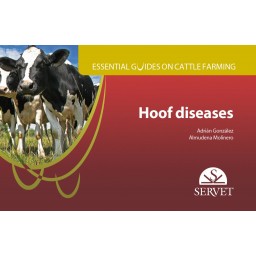
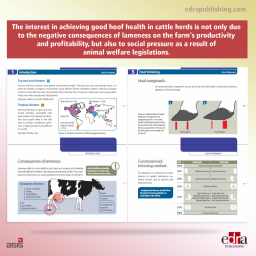
A visual and instructive book written by experts in the field, which shows readers how to analyse the most important characteristics of lameness and the main measures for its control and optimal prevention.
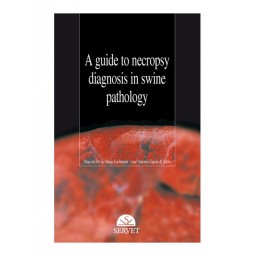
In this book we first propose the correct way to make a quick and complete necropsy which reveals the different organs and structures, offering a technique that can provide us with as much information as possible. Secondly, and directly connected with the necropsy process and maintaining both the orders and the observation plane, we show a significant number of lesions with their respective interpretations and possible relationships with one or more diseases.
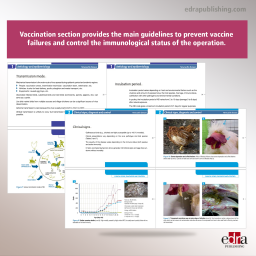
Updated review of Newcastle disease presented in a visual and practical manner. The chapter dedicated to the clinical diagnosis of the disease will surely be of great interest to the reader. The vaccination section provides the main guidelines to prevent vaccine failures and control the immunological status of the operation.
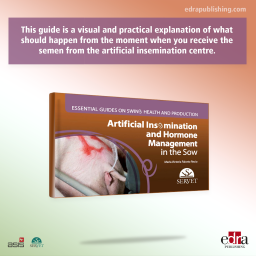
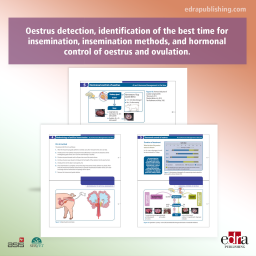
This guide is a visual and practical explanation of what should happen from the moment when you receive the semen from the artificial insemination centre, until the moment when the sow is inseminated, with a focus on the use of refrigerated semen: conservation and management of seminal doses, oestrus detection, identification of the best time for insemination, insemination methods, and hormonal control of oestrus and ovulation.
Technical work mainly focused on the management of pig farms working with hyperprolific genetics, which almost completely monopolize the market in this species in both productive and reproductive terms. The author, a renowned experienced specialist in swine genetics, provides key information to facilitate the management of these lines by veterinary professionals.